Robots that Behave Like a Material, Why and How
In briefAI summary — tap to read
Dr. Matthew Devlin from UC Santa Barbara explores how researchers design robots that can collectively change shape and behave like different materials, drawing parallels to science fiction concepts like the T1000 and nanobots. The talk emphasizes how scientists approach technological challenges, handle failures, and maintain adaptability in their research.
Key takeaways
- Collective robot systems can be engineered to mimic material properties by changing shape and configuration, blending biological inspiration with robotics.
- The development of morphing robot technologies requires researchers to embrace adaptability and learn from both successes and inevitable failures.
- Understanding how to overcome obstacles in research demonstrates valuable problem-solving skills applicable to education, careers, and personal growth.
- Robotics that behave like materials represents an intersection of biology, physics, and engineering that brings science fiction concepts closer to reality.
About Dr Matthew DevlinDr. Matthew Devlin is a professor and researcher at UC Santa Barbara working on collective robotic systems and adaptive technologies.
AI-generated from the meeting recording — AI can make mistakes, so check the recording for anything important.
New here? How our meetings work
Is this your first time visiting us? If so, welcome to our weekly online meeting! To complete our meeting, please continue reading from here to the bottom of this page. Each Monday, our week’s meeting is posted early in the morning, U.S. Pacific Time. These meetings are designed so that you can read and watch what we post anytime during the week. The entire meeting takes about 60 minutes to complete, with the video conference recording of the program being the bulk of the time. Note that you can easily read this meeting with your favorite device, so feel free to take our meeting on the go with you. Please also complete the attendance form at the bottom and leave a comment. Enjoy!
To properly attend this meeting, please:
-
Read and watch the content below in its entirety.
-
Complete the attendance survey.
Everyone is encouraged to leave a comment in the Disqus section at the bottom of the page.
Message from our president
Want to Learn More About Us? - Who We Are, What We Do, Why We Do It
Want to become a Rotarian? - Join us in helping to make the world a better place!
Welcome Members, fellow Rotarians, friends, and guests. Thanks for joining our weekly meeting!

So. California Wildfire Disaster Relief Link
Weekly Funny with Shags
We believe laughter is an important part of life, and we should all make time to laugh a little. This segment of our meeting is meant to tickle you just enough. These funnies are curated by member Steven "Shags" Shagrin!
The Forgotten Name
I'm not the easiest guy in the world to get along with. So when our anniversary rolled around, I wanted my wife to know how much I appreciated her tolerating me for the past 20 years. I ordered flowers and told the florist to enclose a card that read, 'Thanks for putting up with me so long.'
When my wife got the delivery, she called me at work.
"Just where do you think you're going?" she asked.
"What do you mean?" I said.
She read the card aloud as the florist had written it: "Thanks for putting up with me. So long."

Inspiration
If "Don't try this at home" fits within your definition of inspirational video, you'll love this one.

Learn something new
Why Are Some People Left Handed?
Today, about one-tenth of the world’s population are southpaws. Why are such a small proportion of people left-handed -- and why does the trait exist in the first place?


📬 Are you receiving the Members-Only Weekly Bulletin?
Our Club News and Member links are now on the Members Only ClubRunner Site and are emailed weekly as a Club Bulletin. Please make sure your email address is current on ClubRunner.
Members, be sure to read our Weekly Club Bulletin, which is sent separately to your email address from ClubRunner each Monday. In it, you will find updates and information about what our members are up to, club activities, projects, Happy Dollars, news from District 5170, and various ways you can support The Rotary Foundation. We also send your Dues notices using ClubRunner email.
Our Weekly Bulletin, sent every Monday, provides club information. To stay informed, please ensure your email is current on ClubRunner and add mailservice@clubrunner.ca to your address book so it does not go into Spam.
Program: Robots that Behave Like a Material, Why and How
Speaker: Dr Matthew Devlin
We bring you a new program every week on innovation, entrepreneurship, and education and how they contribute to service to others.
When we look to science fiction, there are many examples of impossibly smart materials. The T-1000 from Terminator 2 comes to mind, being able to have a body that can heal and reshape at will. Or, much friendlier, the "nanobots" from Big Hero 6, a large collective of small robots that can create any shape at will.
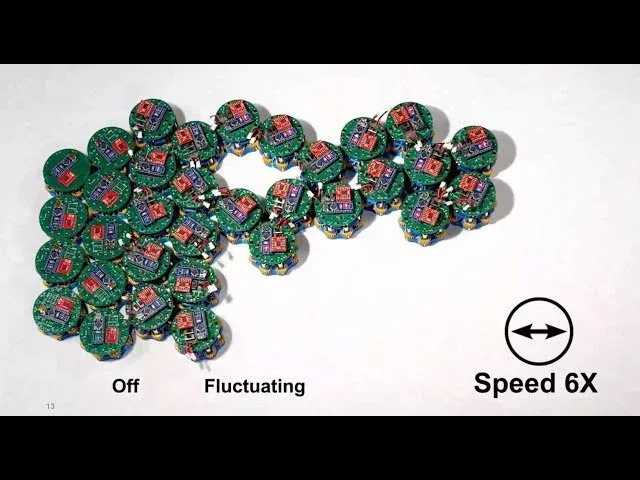
In real life, embryonic tissue is the closest thing to these fantastical materials. It can change its shape, create complex structures, and even change its internal strength, able to melt and flow like a liquid. In a collaboration of roboticists and embryo physicists, the speaker and his co-authors made a collective of robots that embeds these principles, hopefully representing the first step toward uncovering the physics that could govern these sci-fi robotic materials.
Our speaker, Dr Matthew Devlin, is a mechanical engineer from UC Santa Barbara who has recently published a paper called "Material-like robotic collectives with spatiotemporal control of strength and shape" in the journal Science. A small team made up of robotics engineers and embryo physicists were able to distill some of the key principles of embryonic tissue and demonstrate them in robots. He believes it is a key piece of the puzzle for a Big Hero 6 or Terminator-like robotic material.
Members and guests, please welcome Dr Matt Devlin!

To learn more, go to:
this paper published in the Journal Science:
https://www.science.org/doi/10.1126/science.ads7942
A news article written by UCSB giving a high-level explanation:
https://news.ucsb.edu/2025/021769/how-get-robot-collective-act-smart-material
To learn more about the Rotary eClub of Silicon Valley, go to:
http://rotary.cool
Our Three Podcast Series
Our main program speakers are available as podcasts in addition to YouTube videos! Each week, they are available on Spotify and Apple podcasts.
Or you can click below for this week’s speaker:
The Weekly Rotarian
Inspiring Solutions for a Better World
And our original podcast, featuring some of the best of our previous speakers, is still available on Spotify and Apple Podcasts
Development Success Stories
Our third podcast features success stories about economic development from around the world. It is available on Spotify and Apple Podcasts, or you can click below.
Upcoming program recording schedule
All of our guest speakers and programs are recorded live online over Zoom video conference. We welcome members and guests to join us in one of these upcoming recordings. Recordings are approximately 30 minutes long and are subject to change without notice.
Our online video conference room link for these recordings is always http://zoom.siliconvalleyrotary.com/. You are welcome to join us! Please note the timezone listed for all recordings is US Pacific Time (San Francisco, California, USA).
If you can’t join the live recording, please send your questions for an upcoming speaker to programs@siliconvalleyrotary.com.