Microforests, Big Change: Growing Ecological Resilience in Urban Communities
In briefAI summary — tap to read
Daniela Shebitz and John Evangelista presented microforests—densely planted mini-forests using the Miyawaki method—as a nature-based solution for urban environmental challenges in communities like Elizabeth, New Jersey. These forests grow 10 times faster than traditional plantings, sequester significant carbon, reduce flooding, and create biodiversity hotspots while reconnecting communities to nature.
Key takeaways
- Microforests use dense planting (30x normal density) to create fast-growing forests that establish ecological functions in just 1-3 years, with 87% tree survival rates.
- Soil remediation and rich native plant communities in microforests increase microbial metabolic activity by 280% and permeability by up to 52 times, with carbon sequestration beginning in year one.
- Community partnership at every stage—from planning through monitoring—ensures local ownership and unlocks social benefits including mental health improvements and environmental justice in historically disinvested areas.
- The Miyawaki method has already expanded to approximately 3,000 documented microforests worldwide, with the speakers creating a methods paper and database to enable replication globally.
- Early results show microforests eliminate localized flooding, reduce urban heat islands, support 60+ bird species, and provide outdoor classrooms for student-led ecological monitoring and research.
About Daniela Shebitz and John EvangelistaDaniela Shebitz is a conservation biology professor at Kean University in New Jersey who leads student research on microforest growth and ecological benefits. John Evangelista directs Groundwork Elizabeth, a community-based environmental organization that designs and implements microforests in partnership with local residents.
AI-generated from the meeting recording — AI can make mistakes, so check the recording for anything important.
New here? How our meetings work
Is this your first time visiting us? If so, welcome to our weekly online meeting! To complete our meeting, please continue reading from here to the bottom of this page. Each Monday, our week’s meeting is posted early in the morning, U.S. Pacific Time. These meetings are designed so that you can read and watch what we post anytime during the week. The entire meeting takes about 60 minutes to complete, with the video conference recording of the program being the bulk of the time. Note that you can easily read this meeting with your favorite device, so feel free to take our meeting on the go with you. Please also complete the attendance form at the bottom and leave a comment. Enjoy!
To properly attend this meeting, please:
-
Read and watch the content below in its entirety.
-
Complete the attendance survey.
Everyone is encouraged to leave a comment in the Disqus section at the bottom of the page.
Greetings members, Rotarians, friends and guests
Want to Learn More About Us? - Who We Are, What We Do, Why We Do It
Want to become a Rotarian? - Join us in helping to make the world a better place!
Thanks for joining our weekly meeting!

Chris Major - Member
Weekly Funny with Shags

We believe laughter is an important part of life, and we should all make time to laugh a little. This segment of our meeting is meant to tickle you just enough. These funnies are curated by member Steven "Shags" Shagrin!
A teenage boy is getting ready to take his girlfriend to the prom. First, he goes to rent a tux, but there’s a long tux line at the shop, and it takes forever. Next, he has to get some flowers. He heads over to the florist, and there’s a huge flower line there. He waits forever, but eventually gets the flowers. Then he heads out to rent a limo. Unfortunately, there’s a large limo line at the rental office. But he’s patient and gets the job done. Finally, the day of prom comes. The two are dancing happily, and his girlfriend is having a great time.
When the song is over, she asks him to get her some punch. He heads over to the punch table, and there’s no punchline.

Inspiration
This video set in an art museum is about opportunities for all. Shout-out to Uniting Ability Links and Bus Stop Films (Australia, I believe) for creating a very cool, thought-provoking piece.

Learn something new
Hydro WHATS?
Not quite a solid, not quite a liquid: Meet hydrogels



📬 Are you receiving the Members-Only Weekly Bulletin?
Our Club News and Member links are now on the Members Only ClubRunner Site and are emailed weekly as a Club Bulletin. Please make sure your email address is current on ClubRunner.
Members, be sure to read our Weekly Club Bulletin, which is sent separately to your email address from ClubRunner each Monday. In it, you will find updates and information about what our members are up to, club activities, projects, Happy Dollars, news from District 5170, and various ways you can support The Rotary Foundation. We also send your Dues notices using ClubRunner email.
Our Weekly Bulletin, sent every Monday, provides club information. To stay informed, please ensure your email is current on ClubRunner and add mailservice@clubrunner.ca to your address book so it does not go into Spam.
Program: Microforests, Big Change: Growing Ecological Resilience in Urban Communities
Speaker: Daniela Shebitz and John Evangelista
We bring you a new program every week on innovation, entrepreneurship, and education and how they contribute to service to others.
Historically redlined urban neighborhoods often face disproportionate environmental challenges, including flooding, loss of biodiversity, urban heat island effects, and air and soil pollution. The Miyawaki afforestation method, featuring dense planting of native species in revitalized soil, offers a fast, nature-based solution for restoring ecological function in these communities. By accelerating natural forest succession up to ten times faster than traditional planting approaches, this technique enables rapid regeneration of degraded urban landscapes.
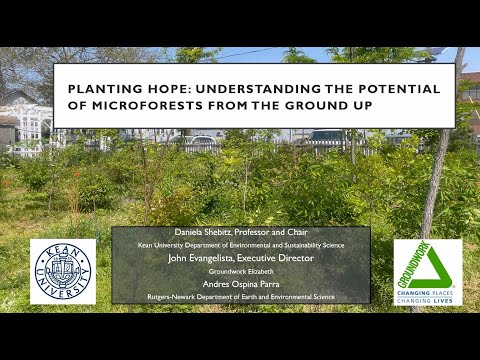
In this presentation, Dr. Daniela Shebitz of Kean University and John Evangelista of Groundwork Elizabeth will share their approach to establishing and monitoring Miyawaki microforests in Elizabeth, New Jersey. They will present preliminary findings from their first four years of research, demonstrating how these forests can help mitigate flooding, reduce heat, and boost biodiversity in the urban environment. Their collaborative work has received national attention, including features in The New York Times (“50 States, 50 Fixes”) and on NBC's TODAY.
Dr. Daniela Shebitz holds a Ph.D. in Ecosystem Science from the University of Washington (2006), as well as a B.S. and M.S. from the SUNY College of Environmental Science and Forestry. An ethnobotanist and plant ecologist, her work centers on integrating traditional and local knowledge into the restoration of culturally significant plants and ecosystems. Her research spans urban communities and Pine Barrens in New Jersey, the tropical rainforests of Costa Rica, and the temperate forests of the Pacific Northwest. Dedicated to advancing sustainability in both education and the broader community, Dr. Shebitz focuses on conservation and restoration ecology, community-engaged learning, urban agriculture, and environmental justice. She chairs Kean University's Department of Environmental and Sustainability Sciences, is a past President of the Society of Ethnobiology, and currently serves as Vice President of the New Jersey Higher Education Partnership for Sustainability (NJHEPS).
Mr. John Evangelista is the Executive Director of Groundwork Elizabeth. With over thirty years of experience in farming, construction and agricultural practices, John works closely with local, state and federal partners to study current urban agricultural practices and introduce them back into underserved areas through educational programs and activities for seniors, adults and children. As director for Groundwork USA's cutting edge environmental project known as the Climate Safe Neighborhood (CSN) partnership, John is working with local residents and stakeholders to increase awareness of the relationship between the city's history of housing segregation and the current and predicted impacts of climate change. Focused on the formerly redlined neighborhoods of Bayway and Elizabethport, and the green lined Elmora neighborhood, the project aims to identify and prioritize climate mitigation measures related to extreme heat, flooding, and CSO events.
Members and guests, please welcome Dr Daniela Shebitz and John Evangelista!
To learn more, go to:
https://groundworkelizabeth.org/
https://www.today.com/video/why-microforests-are-being-planted-in-urban-areas-250008133972
https://www.nytimes.com/2025/07/22/climate/new-jersey-tiny-forests.html
To learn more about the Rotary eClub of Silicon Valley, go to:
http://rotary.cool

Our Three Podcast Series
Our main program speakers are available as podcasts in addition to YouTube videos! Each week, they are available on Spotify and Apple Podcasts, as well as many other platforms.
Our weekly podcast is now called:
Inspiring People — Stories of Innovation and Service
Inspiring Solutions for a Better World
Our original podcast, featuring some of the best of our previous speakers, is still available on Spotify and Apple Podcasts, and many other platforms.
Inspiring Women: Celebrating Trailblazers
Our newest podcast celebrates trailblazing women. It is available on Spotifyand Apple Podcasts, and many other platforms.
Upcoming program recording schedule
All of our guest speakers and programs are recorded live online over Zoom video conference. We welcome members and guests to join us in one of these upcoming recordings. Recordings are approximately 30 minutes long and are subject to change without notice.
Our online video conference room link for these recordings is always http://zoom.siliconvalleyrotary.com/. You are welcome to join us! Please note the timezone listed for all recordings is US Pacific Time (San Francisco, California, USA).
If you can’t join the live recording, please send your questions for an upcoming speaker to programs@siliconvalleyrotary.com.