Airborne Biodiversity Genomics – global-scale nature, wildlife and pathogen monitoring
In briefAI summary — tap to read
Dr. David Duffy presents airborne biodiversity genomics, an emerging technology that recovers DNA from air, water, and sand to monitor wildlife, pathogens, and human populations without direct observation. This non-invasive approach enables rapid, large-scale biodiversity assessments and has applications in conservation, disease surveillance, and water quality monitoring.
Key takeaways
- Environmental DNA (eDNA) technology recovers genetic material shed by organisms into the environment, allowing scientists to identify thousands of species from a single air, water, or sand sample in under 24 hours.
- The approach simultaneously detects wildlife diversity, human ancestry, disease pathogens, allergens, and invasive species, providing rich data for conservation decisions and public health interventions.
- Handheld portable DNA sequencing devices now enable field-based analysis, making global-scale biodiversity monitoring feasible in remote and difficult-to-reach locations.
- Applications include tracking migratory sea turtles across international boundaries, identifying disease vectors like mosquitoes and their pesticide resistance, and pinpointing wastewater contamination sources.
- Ethical considerations around human genetic privacy require careful regulation of when and where human eDNA research should be conducted.
About David DuffyDr. David Duffy leads research at the University of Florida's Whitney Laboratory and Sea Turtle Hospital, where he studies environmental DNA genomics and sea turtle diseases.
AI-generated from the meeting recording — AI can make mistakes, so check the recording for anything important.
New here? How our meetings work
Is this your first time visiting us? If so, welcome to our weekly online meeting! To complete our meeting, please continue reading from here to the bottom of this page. Each Monday, our week’s meeting is posted early in the morning, U.S. Pacific Time. These meetings are designed so that you can read and watch what we post anytime during the week. The entire meeting takes about 60 minutes to complete, with the video conference recording of the program being the bulk of the time. Note that you can easily read this meeting with your favorite device, so feel free to take our meeting on the go with you. Please also complete the attendance form at the bottom and leave a comment. Enjoy!
To properly attend this meeting, please:
-
Read and watch the content below in its entirety.
-
Complete the attendance survey.
Everyone is encouraged to leave a comment in the Disqus section at the bottom of the page.
Greetings members, Rotarians, friends and guests
Want to Learn More About Us? - Who We Are, What We Do, Why We Do It
Want to become a Rotarian? - Join us in helping to make the world a better place!
Thanks for joining our weekly meeting!

Raj Bhandari - Club Member
Weekly Funny with Shags

We believe laughter is an important part of life, and we should all make time to laugh a little. This segment of our meeting is meant to tickle you just enough. These funnies are curated by member Steven "Shags" Shagrin!
Two Eskimos sitting in a kayak were chilly, so they lit a fire in the craft.
Unsurprisingly it sank, proving once again that you can't have your kayak and heat it too.

Inspiration
Let's kick March into high gear with a great motivational messages. Want to get better at something? Here's how to do it. It's the power of "yet."

Learn something new
"People, Let Your Light Shine"
Living things may actually shine with visible light until they die



📬 Are you receiving the Members-Only Weekly Bulletin?
Our Club News and Member links are now on the Members Only ClubRunner Site and are emailed weekly as a Club Bulletin. Please make sure your email address is current on ClubRunner.
Members, be sure to read our Weekly Club Bulletin, which is sent separately to your email address from ClubRunner each Monday. In it, you will find updates and information about what our members are up to, club activities, projects, Happy Dollars, news from District 5170, and various ways you can support The Rotary Foundation. We also send your Dues notices using ClubRunner email.
Our Weekly Bulletin, sent every Monday, provides club information. To stay informed, please ensure your email is current on ClubRunner and add mailservice@clubrunner.ca to your address book so it does not go into Spam.
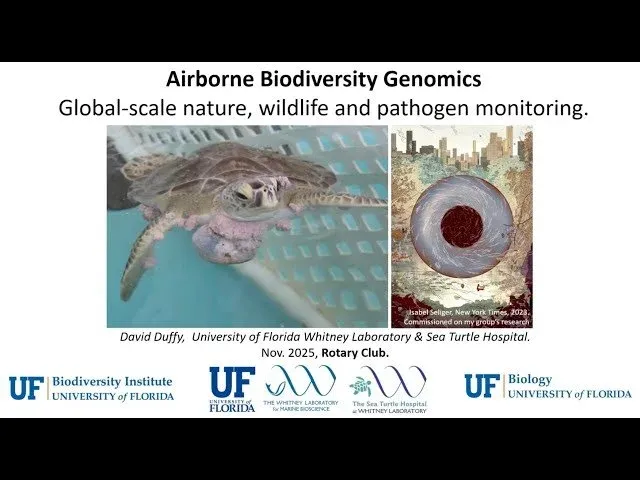
Program: Airborne Biodiversity Genomics – global-scale nature, wildlife and pathogen monitoring
Speaker: David Duffy
We bring you a new program every week on innovation, entrepreneurship, and education and how they contribute to service to others.
The convergence of advanced genomic sequencing technologies and innovative environmental sampling approaches are enabling discovery at whole biome scales and across the tree of life, from microbes to mammals. These technologies are taking us ever closer to the realization of the lifeform detection capabilities of the fictional Star Trek tricorder. Environmental DNA (eDNA) comprises trace amounts of genetic material shed by organisms as they traverse and interact with their environment. Genetic material can enter the environment from shed skin, hair, scales, bodily fluids, defecation and even with every exhaled breath. This genetic material can now be recovered from the air, water or sediment samples, and can reveal a wealth of information about a region’s inhabitants, from sea turtles to bobcats (lynx), humans to mosquitoes, and even microbes and allergens.
These ultra-rich eDNA genomics datasets can be used to quantify the genetic material from each organism and understand what species are present, their origin, and their genetic diversity. These emerging technologies enable the simultaneous study of viral to vertebrate genomes, and unlock their genetic secrets for a wide variety of downstream applications. These include (1) biodiversity monitoring, (2) flora, fauna and microbial population genetics, (3) pathogen and disease vector genomic surveillance, (4) allergen and narcotic surveillance, (5) antimicrobial resistance surveillance, (6) ecosystem-scale genome mining for drug discovery, and (7) human genetic diversity, disease risk, and genetic ancestry analyses from airborne DNA. This talk will introduce recent advances in airborne DNA genomics, discuss their implications, and explore their promise for diverse fields such as endangered wildlife conservation, genetic diversity and drug discovery, and pathogen and disease vector surveillance.
David Duffy is the Condron Family Endowed Associate Professor of Wildlife Disease Genomics at the University of Florida’s Whitney Laboratory for Marine Bioscience & Sea Turtle Hospital, with over 20 years' experience in molecular, genomics, wildlife conservation, cancer and environmental studies. His team conducts laboratory-based, clinical, computational and field-based research. His lab focuses on threats to sea turtles and biodiversity, including plastic ingestion and a sea turtle cancer induced by a pathogen and pollution exposure. The lab also works on the development of advanced eDNA technologies for wildlife, biodiversity, pollution and pathogen monitoring. This includes eDNA analysis from air, sediment and aquatic (freshwater, seawater, estuarine) sources. They also pioneer human eDNA applications.
Members and guests, please welcome David Duffy!

To learn more, go to:
To learn more about Dr Duffy's work, go to:
https://www.whitney.ufl.edu/people/current-research-faculty/david-duffy-phd/
Science media article on airborne eDNA:
https://www.science.org/content/article/dna-captured-air-could-track-wildlife-invasive-species-and-humans
Sea Turtle Hospital webpage:
https://www.whitney.ufl.edu/conservation--sea-turtle-hospital/about-the-sea-turtle-hospital/
Paper on airborne DNA genomics: https://www.nature.com/articles/s41559-025-02711-w
Paper on human eDNA and ethics: https://www.nature.com/articles/s41559-023-02056-2
Media article on airborne eDNA:
https://www.rte.ie/brainstorm/2025/0610/1518005-dublin-air-quality-dna-genetics-monitoring/
Media article on airborne DNA genomics: https://www.irishtimes.com/environment/climate-crisis/2025/06/26/scanning-the-air-for-life/
Press release on airborne DNA genomics: https://news.ufl.edu/2025/06/air-environmental-dna/
Human eDNA potential and ethical implications news story:
https://www.nytimes.com/2023/05/15/science/environmental-dna-ethics-privacy.html
Human eDNA potential and ethical implications news story: https://us.cnn.com/2023/05/15/health/human-dna-captured-from-air-scn/index.html
USA Today news story on eDNA capabilities:
https://www.usatoday.com/story/news/2022/08/26/staggering-dna-advances-could-improve-response-climate-change/10000538002/
Sea turtle cancers BBC television segment:
https://www.bbc.com/sport/av/63125522
Sea turtle plastic ingestion news segment:
https://www.firstcoastnews.com/article/life/animals/uf-scientists-collect-sea-turtle-dna-from-sand-water/77-ac1c0331-032a-4148-a10f-f4906a2405dc
To learn more about the Rotary eClub of Silicon Valley, go to:
http://rotary.cool
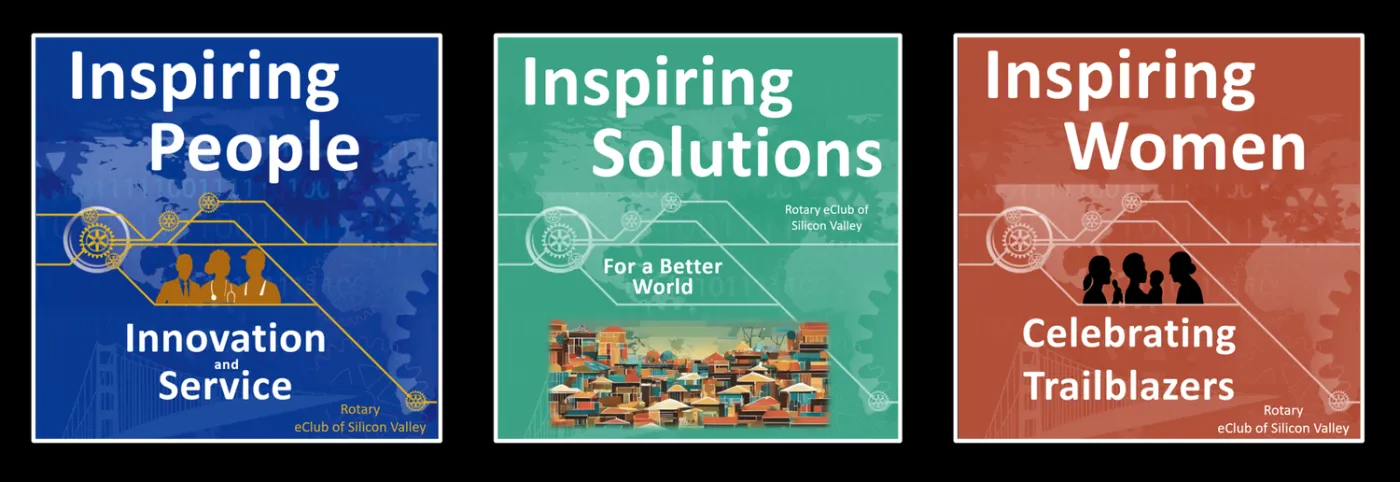
Our Three Podcast Series
Our main program speakers are available as podcasts in addition to YouTube videos! Each week, they are available on Spotify and Apple Podcasts, as well as many other platforms.
Our weekly podcast is now called:
Inspiring People — Stories of Innovation and Service
Inspiring Solutions for a Better World
Our original podcast, featuring some of the best of our previous speakers, is still available on Spotify and Apple Podcasts, and many other platforms.
Inspiring Women: Celebrating Trailblazers
Our newest podcast celebrates trailblazing women. It is available on Spotifyand Apple Podcasts, and many other platforms.
Upcoming program recording schedule
All of our guest speakers and programs are recorded live online over Zoom video conference. We welcome members and guests to join us in one of these upcoming recordings. Recordings are approximately 30 minutes long and are subject to change without notice.
Our online video conference room link for these recordings is always http://zoom.siliconvalleyrotary.com/. You are welcome to join us! Please note the timezone listed for all recordings is US Pacific Time (San Francisco, California, USA).
If you can’t join the live recording, please send your questions for an upcoming speaker to programs@siliconvalleyrotary.com.