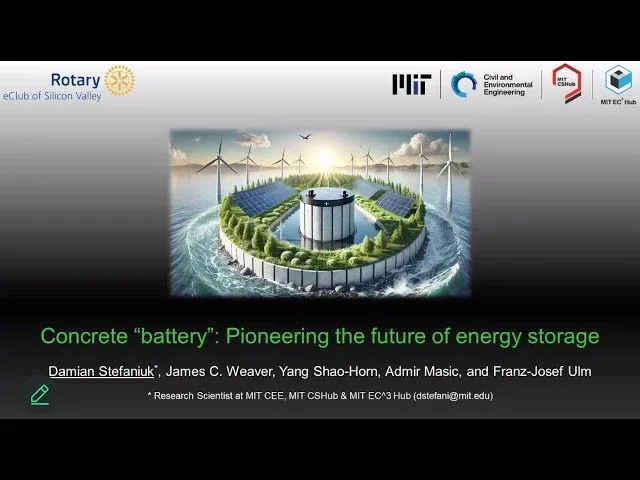
Concrete "Battery": Pioneering the Future of Energy Storage
In briefAI summary — tap to read
Dr. Damian Stefaniuk presents electron-conducting carbon concrete (EC³), a revolutionary material developed at MIT that transforms ordinary concrete into energy-storage devices capable of powering infrastructure. By infusing concrete with nanocarbon black, researchers have created structural supercapacitors that store renewable energy without hazardous waste, potentially enabling self-sufficient buildings and charged roads while addressing concrete's massive carbon footprint.
Key takeaways
- EC³ concrete batteries use nanocarbon black to create conductive networks within concrete, enabling energy storage in structural components like building foundations without additional batteries.
- A prototype concrete column demonstrated the technology's viability by storing enough energy to power LED lights, charge an iPhone, and run arcade games using just 0.003 cubic meters of material.
- With 12 billion cubic meters of concrete used globally annually, deploying this technology could theoretically store 3.6 terawatt-hours of energy, enough to charge 50 million Tesla cars daily or power 360 million off-grid homes.
- EC³ maintains over 90% capacity retention after 100,000 charge-discharge cycles (roughly 137 years of daily use), far outlasting conventional batteries that require replacement every 15 years.
- The technology addresses two major challenges: reducing cement's ~10% contribution to global CO₂ emissions and bridging the supply-demand gap created by intermittent renewable energy sources.
About Dr. Damian StefaniukDr. Damian Stefaniuk is a research scientist at MIT's Department of Civil and Environmental Engineering, specializing in sustainable construction materials and structural engineering. He has worked on concrete research for over 30 years, previously researching corrosion-resistant bridge structures at the University of Houston and nanostructures at Brno University of Science and Technology in Poland.
AI-generated from the meeting recording — AI can make mistakes, so check the recording for anything important.
Meeting for the Week of Jan. 13, 2025
This Meeting at a Glance:
Program: Concrete "Battery": Pioneering the Future of Energy Storage
Speaker: Dr. Damian Stefaniuk
Is this your first time to visit us? If so, welcome to our weekly online meeting! To complete our meeting, please continue reading from here to the bottom of this page. Each Monday, our week’s meeting is posted early in the morning, U.S. Pacific Time. These meetings are designed so that you can read and watch what we post anytime during the week. The entire meeting takes about 60 minutes to complete, with the video conference recording of the program being the bulk of the time. Note that you can easily read this meeting with your favorite device, so feel free to take our meeting on the go with you. Please also complete the attendance form at the bottom and leave a comment. Enjoy!
To properly attend this meeting, please:
-
Read and watch the content below in its entirety.
-
Complete the attendance survey.
Everyone is encouraged to leave a comment in the Disqus section at the bottom of the page.
Message from our president

Welcome our members, fellow Rotarians, friends, and guests. Thanks for joining our weekly meeting!

So. California Wildfire Disaster Relief Link
Ernesto Rodriguez Links:
https://www.cbsnews.com/news/good-things-that-happened-in-2024/
https://mailchi.mp/optimistdaily/newsletter-01-07-2025?e=5f4a41db33
Weekly Funny with Shags
We believe laughter is an important part of life, and we should all make time to laugh a little. This segment of our meeting is meant to tickle you just enough. These funnies are curated by member Steven "Shags" Shagrin!
The Stolen Wallet
It was John's turn to drive carpool into town on a day when a new member was traveling along for the first time. As they rode along, he began to be suspicious of his new carpooling passenger.
John checked to see if his wallet was safe in the pocket of his coat that was on the seat between them, but it wasn't there. He immediately slammed on the brakes, ordered the fellow out, and said, "Hand over the wallet!"
The frightened carpooler handed over a billfold, before John drove off, leaving him alone at the side of the road. When he arrived home that evening, he started to tell his wife about the experience.
Just as he started to recount the whole story, she interrupted him, saying, "Oh, that reminds me, John. Do you know that you left your wallet at home this morning?"

Inspiration
This video is called "Dignity Has a Voice," and it is about the work of families with a member who is disabled in some way to have an active and meaningful outlet for that person. Groups like this often struggle to get those without a loved one with special needs to understand the lack of options our society typically provides its special needs citizens. Please leave a thought in the Disqus section below regarding how you see what the sheltered workshop does for these families.

Learn something new
Stem Cells Explained
As you can tell, I'm on a 1440 Video streak!

📬 Are you receiving the Members-Only Weekly Bulletin?
Our Club News and Member links are now on the Members Only ClubRunner Site and are emailed weekly as a Club Bulletin. Please make sure your email address is current on ClubRunner.
Members, be sure to read our Weekly Club Bulletin, which is sent separately to your email address from ClubRunner each Monday. In it, you will find updates and information about what our members are up to, club activities, projects, Happy Dollars, news from District 5170, and various ways you can support The Rotary Foundation. We also send your Dues notices using ClubRunner email.
Our Weekly Bulletin, sent every Monday, provides club information. To stay informed, please ensure your email is current on ClubRunner and add mailservice@clubrunner.ca to your address book so it does not go into Spam.
Program: Concrete "Battery": Pioneering the Future of Energy Storage
Speaker: Dr. Damian Stefaniuk
We bring you a new program every week on innovation, entrepreneurship, and education and how they contribute to service to others.
This week, we delve into the innovative realm of electron-conducting carbon concrete (EC^3), a revolutionary material that marries the structural capabilities of traditional concrete with advanced energy storage functions. This next-generation concrete employs a unique blend of hydrophobic nano-carbons, binder, aggregate, and water, resulting in electron-conducting carbon network within the cement matrix. The EC^3 technology not only mitigates CO2 emissions typically associated with conventional battery and concrete production but also repurposes carbon black, a prevalent byproduct from, e.g., hydrogen production, thus contributing to a circular economy.
The presentation will showcase the practical applications of EC^3, from powering small electronic devices to its potential in large-scale energy storage solutions. We will highlight its crucial electro-chemical properties and explore its future applications. By integrating energy storage directly into construction materials, EC^3 technology paves the way for energy-autarkic shelters, self-charging roads, and more resilient power grids, fundamentally transforming how we approach sustainable construction and energy management. Join us to discover how EC^3 is set to redefine the boundaries of structural materials and energy storage solutions!
Dr. Damian Stefaniuk serves as a Research Scientist within the Massachusetts Institute of Technology (MIT) Department of Civil and Environmental Engineering, the MIT Concrete Sustainability Hub (CSHub), and the MIT Electron-conductive Cement-based Materials Hub (EC^3 Hub). He is a structural and materials engineering scientist specializing in the development of sustainable construction materials and structures. In his research he focuses on science-enabled engineering of sustainable cement-based materials, with applications ranging from designing corrosion-resistant prestressed bridge structures to exploring chemically induced pre-cure carbonation for carbon storage and developing electron-conductive carbon concrete for renewable energy storage. The overall goal of his research is to make civil engineering infrastructure part of the solution of the urgently needed energy transition while mitigating greenhouse gas emissions associated with cement production.
Members and guests, please welcome Dr. Damian Stefaniuk!

To learn more, take a look at any of these posts:
PNAS article (07/31/2023)
Carbon–cement supercapacitors as a scalable bulk energy storage solution
https://doi.org/10.1073/pnas.2304318120
BBC (06/11/2024)
The cement that could turn your house into a giant battery
https://www.bbc.com/future/article/20240610-how-the-concrete-in-your-house-could-be-turned-into-a-battery
Boston Globe Media (08/22/2023)
Is cement the solution to storing renewable energy? Engineers at MIT think so
https://www.bostonglobe.com/2023/08/22/business/mit-supercapacitor-stores-renewable-energy/?
World Economic Forum (08/20/2023)
These scientists are using widely available materials to create an alternative to batteries
https://www.linkedin.com/feed/update/urn:li:activity:7097940811811545088?utm_source=share&utm_medium=member_desktop
MIT News (07/31/2023)
MIT engineers create an energy-storing supercapacitor from ancient materials
https://news.mit.edu/2023/mit-engineers-create-supercapacitor-ancient-materials-0731
Our Three Podcast Series
Our main program speakers are available as podcasts in addition to YouTube videos! Each week, they are available on Spotify and Apple podcasts.
Or you can click below for this week’s speaker:
The Weekly Rotarian
Inspiring Solutions for a Better World
And our original podcast, featuring some of the best of our previous speakers, is still available on Spotify and Apple Podcasts
Development Success Stories
Our third podcast features success stories about economic development from around the world. It is available on Spotify and Apple Podcasts, or you can click below.
Upcoming program recording schedule
All of our guest speakers and programs are recorded live online over Zoom video conference. We welcome members and guests to join us in one of these upcoming recordings. Recordings are approximately 30 minutes long and are subject to change without notice.
Our online video conference room link for these recordings is always http://zoom.siliconvalleyrotary.com/. You are welcome to join us! Please note the timezone listed for all recordings is US Pacific Time (San Francisco, California, USA).
If you can’t join the live recording, please send your questions for an upcoming speaker to programs@siliconvalleyrotary.com.